Tag: Evidence & uncertainty

How to read health claims without fear or absolutism.

  • From Tomatoes to Toxins

    From Tomatoes to Toxins

    From Tomatoes to Toxins

    I didn’t use to think much about organic food. It was there, more expensive, vaguely ‘better for you’, and that was about as far as my interest went.

    Then the algorithm found me.

    It clocked a new, slightly anxious mum watching anything about children and family health, and started feeding me videos designed to unsettle me just enough to keep me watching. It worked.

    I started seeing the footage of fields being sprayed with glyphosate, the warnings that our food was covered in cancer-causing chemicals, that children were particularly susceptible, that you should buy everything organic or, if you can’t afford that, at least avoid the “dirty dozen”. Which, by the way, are often the most expensive produce in the shop. In the UK, you would need a substantial household income to feed a family entirely organic.

    The Guilt Spiral

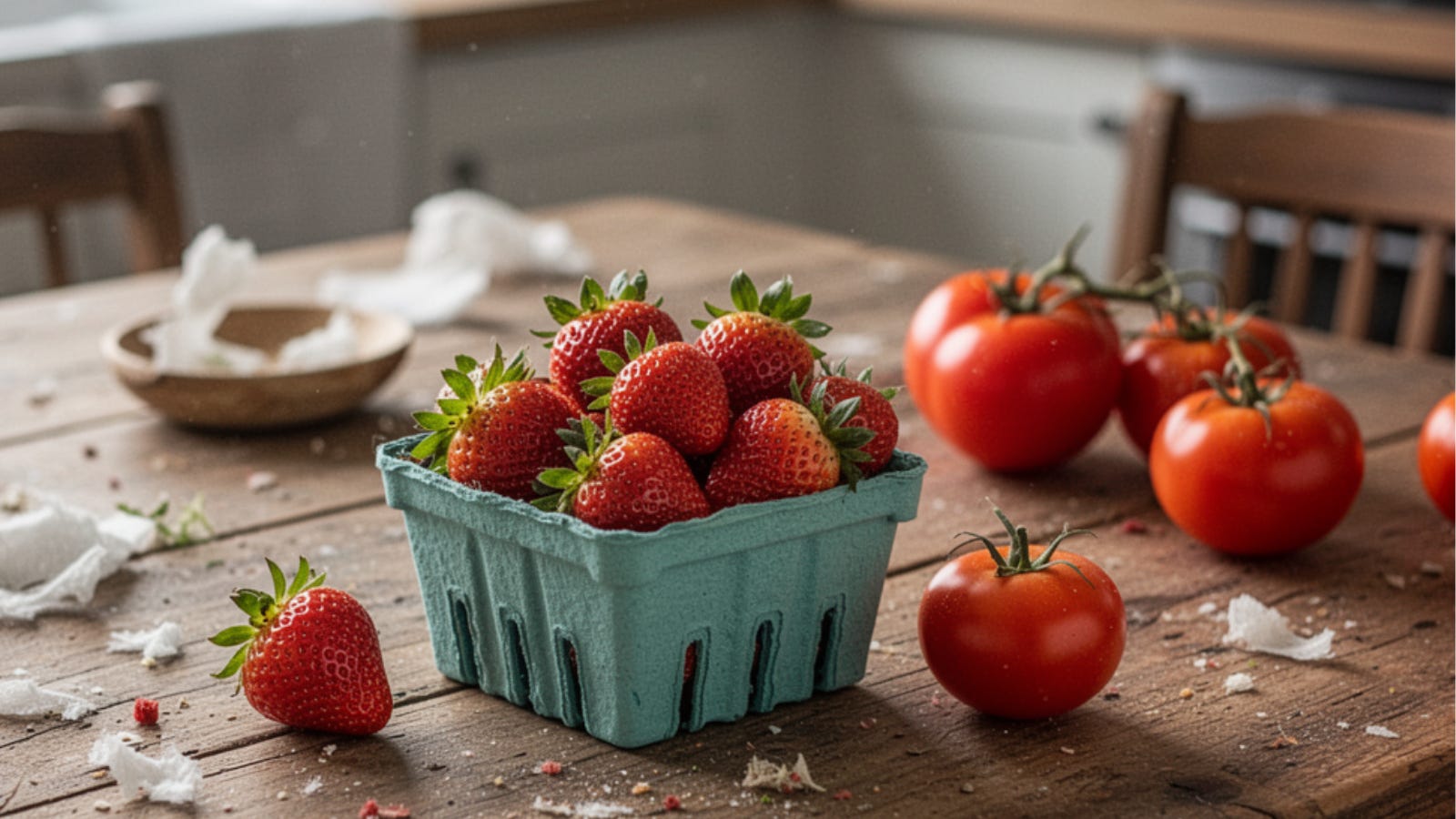
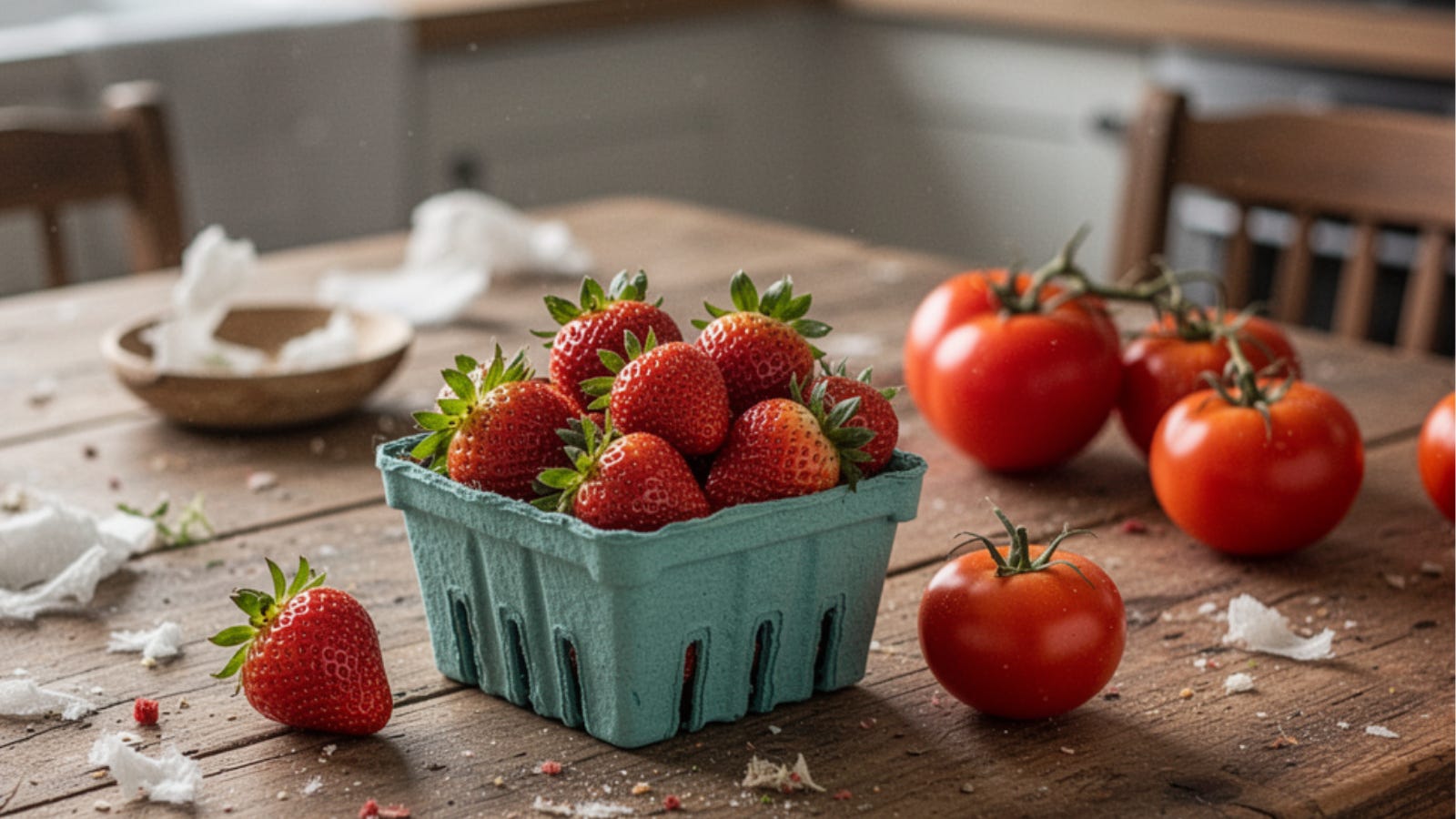
    At first, it was just background noise, but the videos kept coming. I went from feeling chuffed when my daughter ate a tomato to thinking, “What chemicals are in that? I didn’t wash it long enough. Should I have used baking soda? The organic ones are £5 but most of them end up on the floor.” I remember one episode in particular. I should have been enjoying a relaxed meal at someone else’s house. My daughter was happily tucking in when the berries arrived, straight from the packet and unwashed. My stomach tightened. I found myself sneaking them off her plate and taking them to the sink when no one was looking.

    I know that isn’t entirely rational. But having lost a close family member too young, and having looked after patients dying from cancer, anything framed as a cancer risk hits me hard. I’ve worked in paediatrics. I’ve seen what families go through. When I see suggestions that what I’m feeding my children could influence something like that, even slightly, it goes straight past logic and lands in fear.

    The guilt voice is relentless: you know better. You could afford organic if you cut back elsewhere. You shouldn’t have cancelled the veg box. What if that strawberry is covered in PFAS and glyphosate?

    Alongside that is the louder online narrative: governments are in bed with big agriculture, studies can’t be trusted, we are knowingly being fed poison. I don’t believe scientists are corrupt. Most are trying to do good work. But systems aren’t perfect. And I can’t completely silence the quieter question underneath it all: even if exposure is below “safe” thresholds, what does daily cumulative exposure over decades mean? Are children more sensitive?

    When I finally had a bit more emotional bandwidth, I decided to step back and look properly at what the research actually shows. As usual, the science is quieter and more complicated than the online conversation. Full disclosure: I’m not running pesticide assays in a lab. I’ve looked at the larger population studies and broader reviews. The field is still developing, but broadly, there are three questions.

    Do health outcomes actually differ between people who eat more organic food and those who don’t?

    There are only a few very large studies. Some analyses, including work from a large French cohort, suggest people who report eating more organic food have slightly lower rates of certain cancers, particularly non-Hodgkin lymphoma. Large UK data have not shown a clear reduction in overall cancer risk.

    These are observational studies. They ask people about their diet and follow them over time. People who choose organic often differ in many other ways too: income, education, smoking, exercise, and overall diet quality. Researchers adjust for this, but it’s extremely difficult to completely separate organic food from a broader health-conscious lifestyle. We see associations, not proof of cause.

    What about pesticide residues themselves?

    Organic produce generally has lower detectable residues. That part is fairly consistent. Conventional produce is usually within regulatory safety limits, which include built-in safety margins. Detectable does not automatically mean dangerous. It means exposure exists, typically at low levels. That distinction tends to disappear online.

    Thirdly, is organic food actually more nutritious?

    Some reviews suggest organic produce may contain slightly higher levels of certain antioxidants and plant compounds like polyphenols. The differences aren’t dramatic, and overall diet quality matters far more than whether a tomato is organic or not. But the idea that organic is purely a marketing gimmick isn’t entirely accurate either.

    Where it tips into fear

    One of the first things I noticed when I stepped back was the tone.

    “Humans are the only species who spray poison on their food to stop things eating it… and then eat it themselves.”

    Cue ominous music. Slow-motion footage of tractors spraying fields. A smug influencer standing in front of their homegrown kale.

    There’s no room for uncertainty. No space for context. It’s framed as a revelation. As a conspiracy. As a hidden truth.

    “Our food is being laced with cancer-causing chemicals.”
    “This is why we’re all unwell.”
    “The government doesn’t want you to know.”

    The studies might say “association”. The video says “cause.” The data might say “low-level exposure within regulatory limits.” The caption says “toxic.” Detectable becomes dangerous. Possibility becomes inevitability.

    And it works. Even knowing how algorithms amplify fear, I could feel my blood pressure rise researching this.

    This is what I have a problem with. The messaging often leaves ordinary people (who are already trying their best) feeling guilty for not buying organic or growing their own food. Most families do not need another layer added to an already heavy mental load.

    In an ideal world, perhaps we would all eat organic. It may well be better for the environment, and it’s reasonable to question whether repeated low-level exposure over decades is entirely benign. That’s a fair conversation.

    But guilt is not a public health strategy.

    The worst possible outcome, in my view, would be discouraging people from eating fruit and vegetables at all. Blueberries often appear on the “worst offenders” lists. But there is no evidence to suggest that someone is better off eating no blueberries than eating conventionally grown ones.

    Putting it in context

    Once the initial panic settled, I started asking a different question – not “is this toxic?” but “where does this sit in the bigger picture of health?”

    Most of us reading this are already trying. And in that, we’re fortunate. We have enough resources to even ask how to make things better. For a huge proportion of the world, the question isn’t whether food is organic. It’s whether there is enough.

    In countries like the UK and US, most of us aren’t getting the basics right. The foundations aren’t glamorous: more whole foods, fewer ultra-processed ones, more plants, less added sugar. It won’t go viral. But it likely matters far more than whether a punnet of berries is organic.

    If those foundations are solid (I’m still working on mine), then perhaps organic becomes the next layer. A refinement. A tweak. Not the starting point.

    It’s a layer on top, not the foundation.

    This topic doesn’t fit neatly into one newsletter. The science is complicated, the messaging is not, and somewhere in the middle is where most of us are trying to feed our families. So I’m splitting this in two. Today was about the fear, the guilt voice and what this actually feels like in real life. Next week, I’ll look more closely at the research: pesticide exposure, cancer data, ADHD findings, the Dirty Dozen lists – and what they really show.

    I haven’t dismissed the concerns, and I want to look at the evidence more closely. But I’m not spiralling in the way I was. The guilt has softened, and that feels like a healthier place to start.
  • Are Ultra-Processed Foods Really That Bad? What the Evidence Says (and What Real Life Looks Like)

    Are Ultra-Processed Foods Really That Bad? What the Evidence Says (and What Real Life Looks Like)

    Are Ultra-Processed Foods Really That Bad? What the Evidence Says (and What Real Life Looks Like)

    Ultra-processed foods are everywhere in the health conversation right now. A few years ago hardly anyone knew what they were. Now they’re a buzzword, attached to everything from cancer to dementia to obesity. The messaging is strong. Avoid them at all costs. They’re slowly killing you. If they’re in your trolley, you clearly don’t care about your health. Even with a background in nutrition, I feel it.

    A few years ago, when I first started reading about the potential risks, I got sucked in and went all out. I gutted the cupboards, read every label, and if something had more than a handful of ingredients, it didn’t make it past the trolley. Everything had to be made from scratch. No jars. No shortcuts. This lasted about two weeks, which is roughly how long it took me to realise what that level of vigilance actually required. Every snack, every lunchbox, every dinner needed planning, prep and energy I simply didn’t have. Food became a project. I was stressed, slightly resentful, and not obviously feeding anyone better. Just feeding them later and in a worse mood.

    So I stepped back and did what I probably should have done in the first place. I went back to the research. What I found didn’t make me dismiss the concerns, but it did make me calmer. It helped me separate what the evidence actually shows from what gets amplified online, and it helped me fit the conversation into my real life in a way that wasn’t all-consuming.

    What Do Large Studies Show About Ultra-Processed Foods?

    The term “ultra-processed food” has become shorthand for “unhealthy”, but the reality is more complicated. Large population studies consistently show that diets high in ultra-processed foods are associated with poorer health outcomes. Higher rates of obesity, cardiovascular disease and some cancers have been reported across multiple countries. Often there is a dose–response pattern: the more ultra-processed food in the diet, the higher the observed risk.

    However, most of this research is observational. It identifies patterns across populations and cannot prove that processing itself directly causes disease. People who eat high amounts of ultra-processed food often differ in many other ways too: income, stress, working hours, smoking, sleep, physical activity and access to healthcare. Researchers adjust for these factors, but adjustments are never perfect.

    One study even found that higher ultra-processed food intake was associated with accidental deaths. Ultra-processed food does not biologically cause car accidents. What this likely reflects is clustering of behaviours and social circumstances that are difficult to untangle. So while the overall association is consistent, we should be cautious about assuming every link reflects a direct biological effect of processing itself.

    The scientific conversation is cautious and developing. The online conversation is often not.

    Part of the confusion lies in interpretation. Headlines often imply that all foods labelled ultra-processed are equally harmful. But when researchers look more closely, the strongest associations tend to be driven by specific categories, such as sugary drinks and processed meats, rather than every food captured under the UPF umbrella. The most widely used classification system, NOVA, categorises foods by degree of processing, not by nutritional value. Processing and health are related, but they are not the same thing.

    So what might explain the harm, if it exists?

    Why Might Ultra-Processed Foods Be Harmful?

    If there is harm here, it’s unlikely to be for a single reason.

    Ingredients are part of it. Many ultra-processed foods are high in added sugar, salt and saturated fat, and often contain various additives. Most additives pass safety testing and are not acutely toxic. That’s important to say. At the same time, emerging research suggests that some emulsifiers and other additives may influence the gut microbiome or metabolic health over time. This area is still evolving, and not all additives are harmful. Some, such as added fibres like inulin, may even have benefits.

    Nutrient profile also matters. Diets high in ultra-processed foods tend to be lower in fibre and beneficial plant compounds, and higher in energy density. That combination makes foods easier to overconsume and more likely to displace more nutrient-rich options.

    Then there is the food matrix, which is often overlooked. Processing can alter the physical structure of food even when the ingredient list looks similar. Whole almonds and almond flour contain the same nutrients, but whole almonds are digested more slowly and lead to lower calorie absorption. A whole apple, apple purée and apple juice begin as the same fruit but have very different effects on blood sugar, satiety and subsequent intake. When structure is disrupted, food is digested more rapidly, blood sugar tends to rise more quickly, fullness signals are weaker and overall intake often increases.

    What the Research Misses (and Where I Land)

    What the research doesn’t really capture is what it feels like to feed people when you’re tired and responsible for everything else. It doesn’t measure time, energy or the mental load of deciding what everyone is going to eat every day. When I tried to eliminate ultra-processed foods entirely, food became a full-time project. I didn’t just need good intentions. I needed capacity, and capacity isn’t unlimited.

    They’re also harder to avoid than it sounds. Added ingredients are everywhere — tinned beans, yoghurt, bread, curry pastes, even herbs and spices. You can get home feeling vaguely virtuous and then discover the “healthy” thing you bought contains emulsifiers and colourings you weren’t expecting. That annoys me more than the obvious chocolate bar. At least the chocolate bar isn’t pretending.

    If I’m honest, I don’t have the mental bandwidth to cook everything from scratch. When I’ve tried, I end up stressed and slightly resentful, usually standing in the kitchen at 5pm wondering what exactly I’m supposed to feed everyone. Children are fussy. They like processed snacks. I can offer dark chocolate, but Aunty Emma once turned up with pink chocolate and now there is no going back.

    So I sit somewhere in the middle. A diet high in ultra-processed foods probably isn’t good for us, but completely eliminating them isn’t realistic for most busy lives.

    For me, it comes down to patterns. We eat a lot of bread, so I mostly buy fresh sourdough but keep supermarket versions in the freezer because the children eat extraordinary amounts and I need backup. Over time, I’ve checked the labels on the foods we use most and found versions with fewer additives. Once I find one that seems reasonable, it becomes the staple. Highly coloured, very sugary foods are occasional, mainly because I’ve seen what they do to our “calm” bedtime routine.

    I don’t panic about a jar of sauce. If I don’t have time to make one from scratch, I don’t. Patterns matter more than perfection.

    If You’re Feeling Tired and Guilty About Food

    We all know ultra-processed foods aren’t ideal as the foundation of a diet. But there is only so much you can do with the resources you have – time, money, emotional bandwidth. You are not lazy. You are not failing. You are not harming yourself or your family because dinner came from the freezer or because you didn’t make your own hummus.

    Try to incorporate as many whole foods as you reasonably can. Check the labels on the foods you eat most often rather than everything at once. Make small swaps. Once you’ve found a bread that looks okay, just buy that one and move on. If you need convenience foods for your sanity, use them. Add fruit. Add vegetables if they’ll eat them.

    Patterns over time matter more than one packet of supermarket pittas. You can only do the best you can with the resources you have.

  • Trade-offs no one talks about

    Trade-offs no one talks about

    Trade-offs no one talks about

    A lot of health advice assumes we have endless time, energy, and headspace. That if we just cared enough, planned better, or tried harder, we could optimise everything. And if we’re not managing it, the problem must be us. I don’t think that’s true. I think many of us are constantly making thoughtful compromises, trying to do the best we can for ourselves and our families within very real constraints. Parenting is just one place where this becomes obvious, but the same trade-offs show up with illness, caring for ageing parents, demanding work, or any season where energy is limited. For me, most days are a series of trade-offs rather than ideal choices.

    Screen time while I’m trying to cook is a good example. I’ve seen the videos of perfectly behaved children calmly helping to prepare nutritious meals, everyone smiling. I tried this recently. The result was a whole tub of chia seeds on the floor, a half-eaten banana smeared all over the toddler tower, and raw green beans being eaten enthusiastically, which felt like a win, before being spat straight back out with a loud “yuk yuk”. The end result was me stressed and trying not to lose my temper, a messy kitchen that added another layer of stress, and chia seeds stuck to my socks, which was deeply annoying. By the time dinner was ready, I was irritable, and that mood carried on into the evening.

    If I’d put Teletubbies on for half an hour, the situation would have looked completely different. We still would have had a nutritious, home-cooked meal. Yes, according to the internet, I would have “fried her brain” with thirty minutes of questionable television, but she would also have had a calmer, less irritable mum for bath time and bedtime. In hindsight, expecting a seventeen-month-old to help with dinner was probably slightly over ambitious.

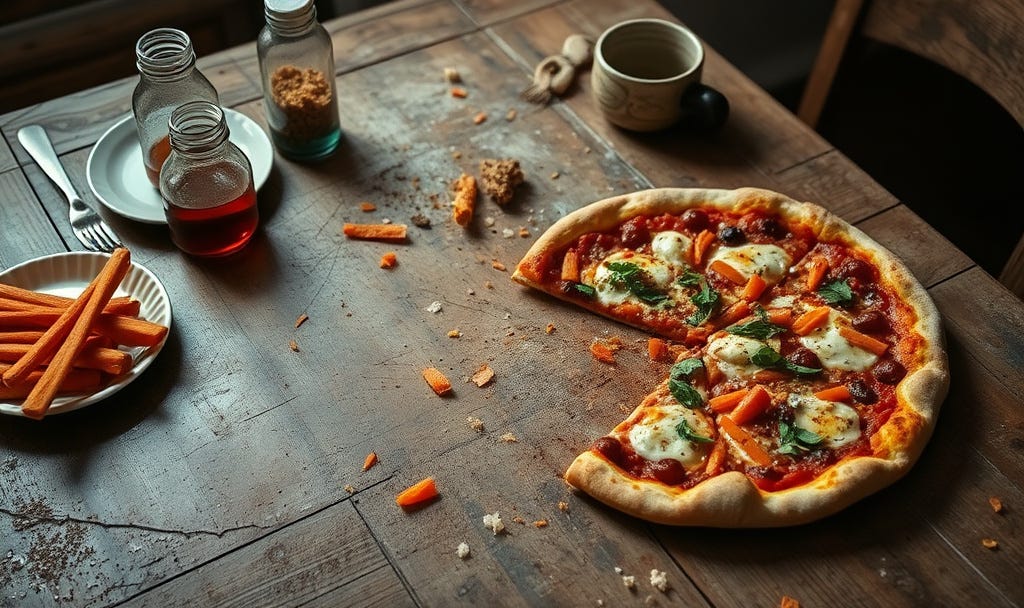
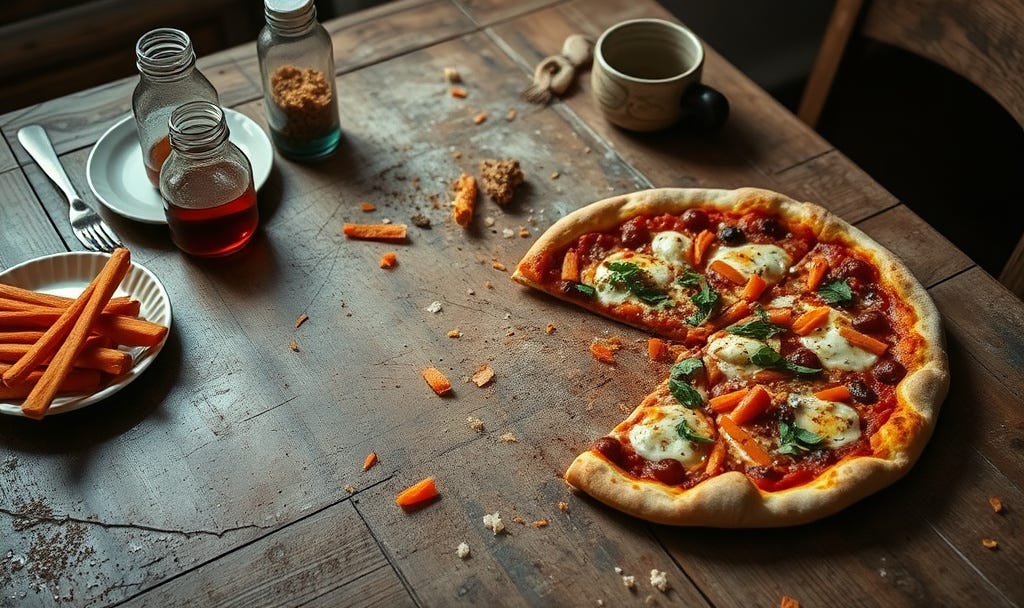
    Food, more broadly, is another place where trade-offs show up clearly. By the time Friday comes around, we are usually completely depleted. The washing is piling up, the fridge is pretty bare, and all the home-cooked food we made earlier in the week has been eaten. I now buy pizzas to keep in the freezer “just in case”, and without fail, we use them every Friday. Each time, I feel an overwhelming sense of relief. Supermarkets are clearly responding to concerns about ultra-processed foods, and I’ve noticed some genuinely positive changes. I’ve found reasonably priced sourdough pizzas that the whole family loves and that don’t contain a long list of ingredients with numbers or words I can’t pronounce.

    I usually serve them with cucumber and carrot sticks, which makes me feel better, even though I’m often the only one who eats the vegetables. But the end of the week is calmer, the children are happy, and it takes a significant weight off my shoulders. That feels like a trade-off I’m comfortable with.

    Sleep is another example. I mentioned this briefly in my previous article, but it’s worth returning to. If I’m honest, and it’s slightly embarrassing to admit, I usually turn the lights out around 8.30 pm. I do it deliberately. It gives me a buffer for the inevitable night wakes and early mornings. The choice is usually between six or seven hours of sleep, often broken, or four to five hours if I stay up later. I do not function well on the latter. A bear with a sore head is a very accurate description.

    Yes, I lose “me” time. I lose evenings with my husband, and that isn’t ideal. But I also know the alternative is worse. Less sleep means less patience, more emotional reactivity, and much less capacity to cope with the day ahead. And sometimes, on good nights, it actually works beautifully. I’ll wake early, often around four (I know this will sound mad to some people), having had a solid seven hours. The house is silent, everyone else is asleep, and I get a short window entirely to myself. That quiet, empty house feels like bliss.

    Cooking for the whole family is another constant negotiation. I find it mentally exhausting trying to balance nutritious meals, children’s preferences (which seem to change daily) and my husband’s keto diet. My own preferences sit firmly at the bottom of the list. It’s time-consuming and requires a surprising amount of emotional energy and decision-making.

    Our diet is fairly repetitive. There is a lot of spaghetti bolognese, chicken curry, and pasta in general, because whatever goes with the pasta, the children will usually eat. They’ve only ever had wholemeal versions, so they don’t even know white pasta exists, and I plan to keep it that way for as long as possible. Broccoli on its own? Absolutely not. Broccoli mixed through pasta? Lovely. Cooked peppers? No chance. Peppers in pasta? A firm favourite. Kidney beans are apparently disgusting, unless they’re in chilli served with pasta, in which case it’s suddenly their favourite meal. You get the idea.

    I vary the vegetables as much as I can and sneak in lentils and other bits where possible, so there is some variety. But it is boring, and at the moment, I don’t get a huge amount of enjoyment from food. Still, there isn’t really an alternative in this season, and I’m fairly sure that will change when things ease up a bit. For now, this will have to do.

    None of this is unique to food or children. It’s simply where the friction shows up most clearly for me right now. I don’t see these choices as failures anymore. They’re not evidence of apathy or lack of care, but of living in a phase where energy is finite and priorities compete. I’m trying to step back from the constant second-guessing and over-analysis, and accept that doing something reasonably well, consistently, is often better than chasing an ideal that only exists on paper.

  • Why so much health advice feels unhelpful

    Why so much health advice feels unhelpful

    Why so much health advice feels unhelpful

    Something that doesn’t sit right with me about health advice is how often it contradicts itself. For every video or post I see saying sugar will kill you, another is insisting it shouldn’t be demonised, that it’s absolutely fine as part of a healthy, balanced diet. For every “meat causes bowel cancer”, there’s a “carnivore diet reduces your risk of cancer”. For every “dairy is inflammatory and increases disease risk”, there are large-scale studies that don’t show this. And don’t even get me started on seed oils.

    If you spend any time online, you’re constantly presented with confident, persuasive messages that directly oppose one another, often delivered with the same level of certainty. It’s no wonder so many people feel confused about what they’re supposed to eat, avoid, prioritise, or worry about. I find it overwhelming too, and I’ve spent nine years at university studying nutrition and medicine, training as a dietitian and later working as a medical doctor in the NHS. I know how to read and critique evidence. I understand the difference between a mechanistic hypothesis, an observational association, and a randomised trial. And even I can’t always figure it all out. You can have people who seem credible, articulate, and well-informed saying opposite things. If someone with this background struggles to navigate it all, how on earth are people without it supposed to? Even knowing to ignore those without credentials doesn’t fully protect you; the videos are well produced, the arguments sound convincing, and they tap into very real fears.

    Something else that doesn’t sit right with me is how strict so much of this advice has become, and how little allowance it makes for people who are simply trying to live normal lives and still enjoy food. Take the constant warnings about toxins, pesticides, and “forever chemicals” in our food, and the insistence that we must eat everything organic. Have the people making these videos seen the price of food recently? How are normal people, with normal jobs and normal budgets, supposed to afford all-organic produce when it often costs two to three times as much? All this has done for me over time is create guilt about the food I feed my children. I can’t afford £6 for a tiny punnet of blueberries, especially when one child could eat it in a single sitting. And yet I’ve found myself watching them shovel fresh berries into their mouths while a small voice in my head whispers, oh god, I’m poisoning them.

    Looking back now, I can see how much unnecessary stress crept into my life over the years. I’m only just starting to see this clearly now that I’m coming out of the pregnancy and baby phase. When I think about the torment I put myself through, it makes me angry, not at myself, but at the way so much health advice is framed, and the effect it has on people. For me, it wasn’t empowering. It was suffocating.

    What I’m trying to offer here instead is a calmer voice of reason amid the chaos of overhyped health advice in the media and on social media. A place where I write about the conclusions I’ve drawn from reading the evidence, and then trying to apply it to my own life, seeing what’s realistic and what isn’t. I want this to be a reassuring voice, one that helps people feel more empowered and less anxious. A space that focuses on what can be done, rather than endlessly ruminating on the things that can’t currently be changed, whether that’s because of time, energy, money, or circumstance. I’m trying to create the kind of place I’d want to go myself for information I trust, somewhere that takes away some of the emotional burden of trying to keep yourself and your family well. Somewhere, people don’t feel so alone, or like they’re constantly fighting a losing battle. I know that feeling well, the sense of thinking what’s the point?, that whatever you do is supposedly wrong anyway. And when it starts to feel unwinnable, it often ends not with better habits, but with giving up entirely. For me, that often ended with a packet of biscuits or a bag of Haribo, not because I didn’t care, but because caring had started to feel impossible.