I didn’t use to think much about organic food. It was there, more expensive, vaguely ‘better for you’, and that was about as far as my interest went.
Then the algorithm found me.
It clocked a new, slightly anxious mum watching anything about children and family health, and started feeding me videos designed to unsettle me just enough to keep me watching. It worked.
I started seeing the footage of fields being sprayed with glyphosate, the warnings that our food was covered in cancer-causing chemicals, that children were particularly susceptible, that you should buy everything organic or, if you can’t afford that, at least avoid the “dirty dozen”. Which, by the way, are often the most expensive produce in the shop. In the UK, you would need a substantial household income to feed a family entirely organic.
The Guilt Spiral
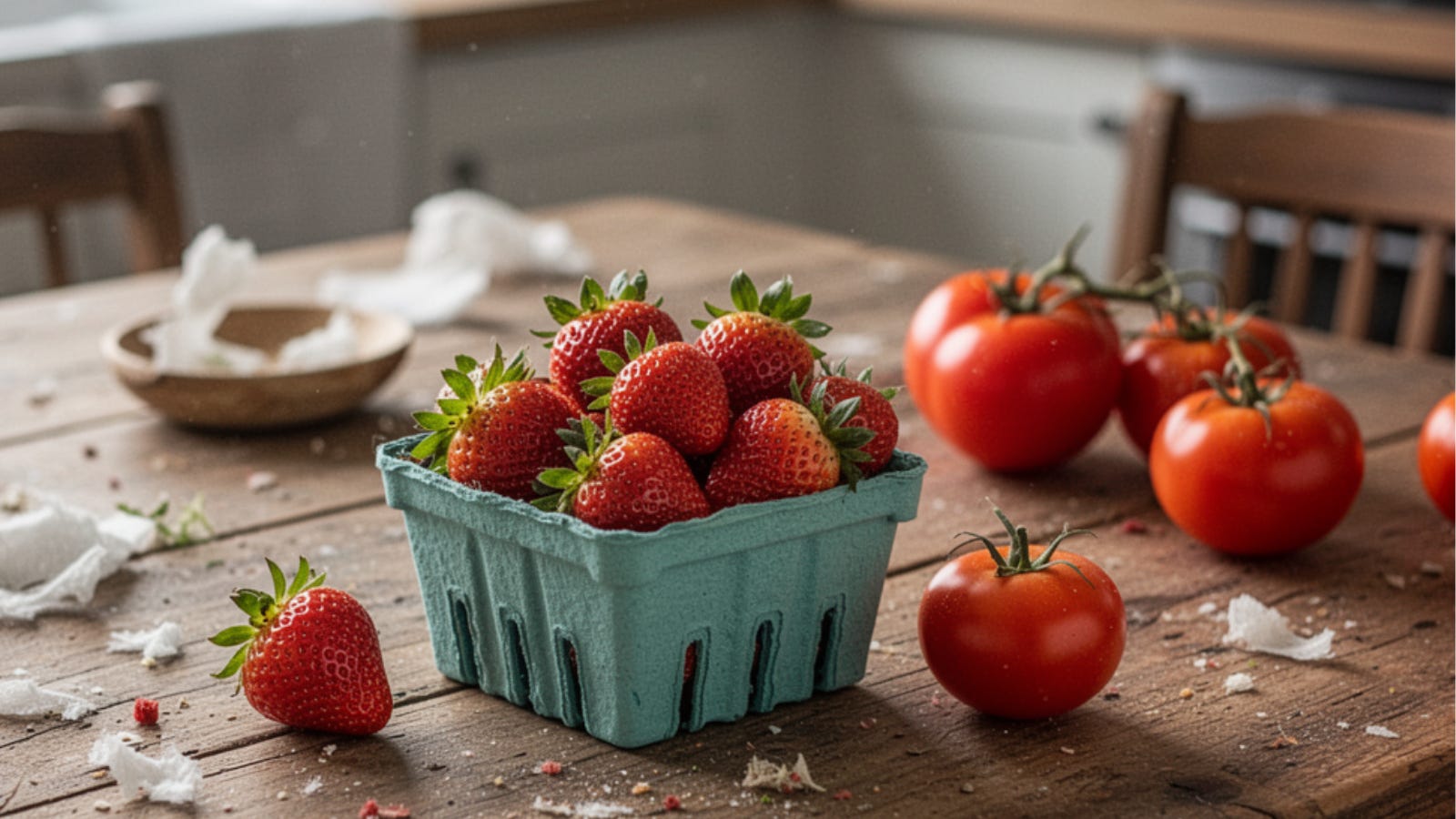
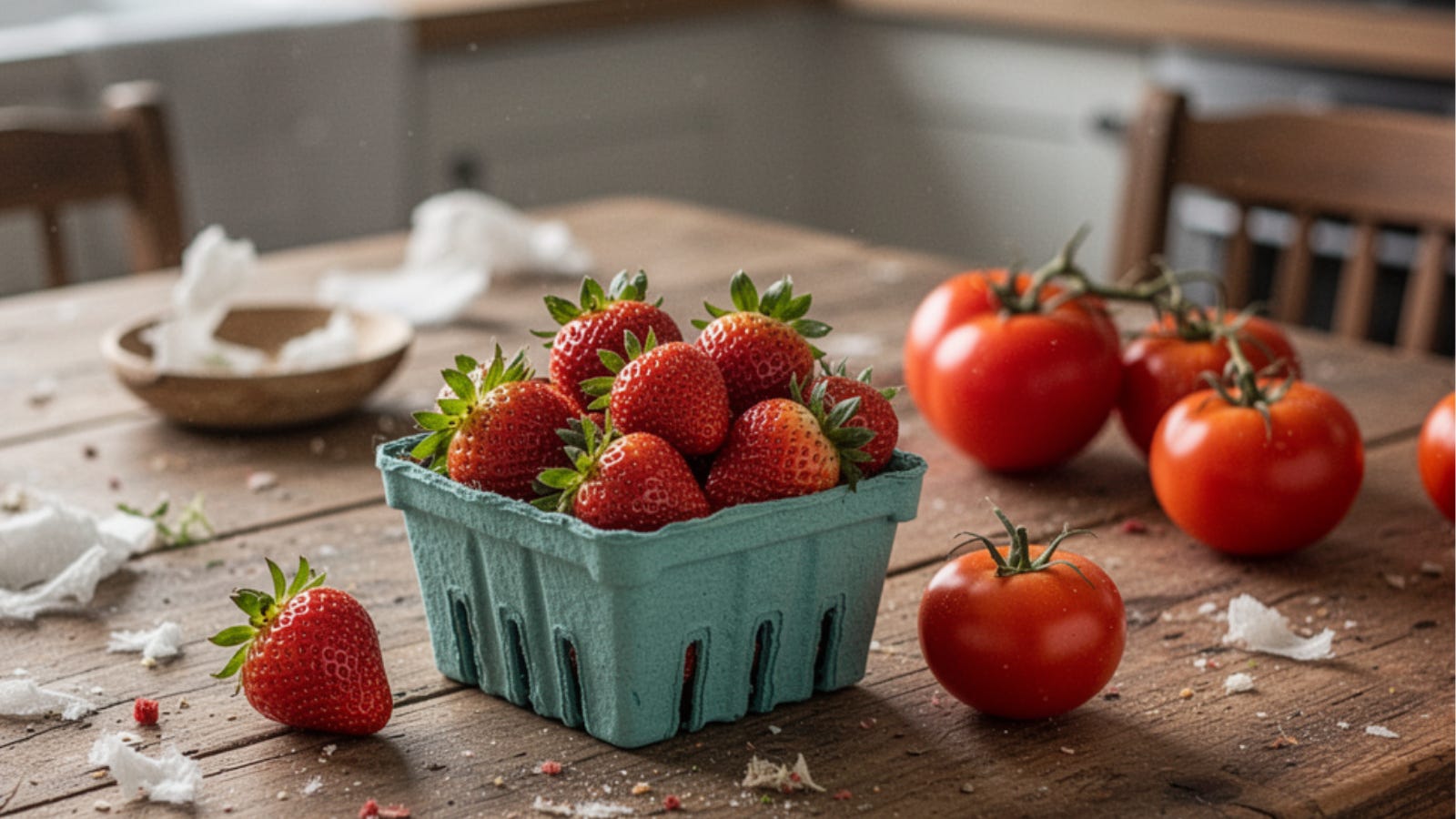
At first, it was just background noise, but the videos kept coming. I went from feeling chuffed when my daughter ate a tomato to thinking, “What chemicals are in that? I didn’t wash it long enough. Should I have used baking soda? The organic ones are £5 but most of them end up on the floor.” I remember one episode in particular. I should have been enjoying a relaxed meal at someone else’s house. My daughter was happily tucking in when the berries arrived, straight from the packet and unwashed. My stomach tightened. I found myself sneaking them off her plate and taking them to the sink when no one was looking.
I know that isn’t entirely rational. But having lost a close family member too young, and having looked after patients dying from cancer, anything framed as a cancer risk hits me hard. I’ve worked in paediatrics. I’ve seen what families go through. When I see suggestions that what I’m feeding my children could influence something like that, even slightly, it goes straight past logic and lands in fear.
The guilt voice is relentless: you know better. You could afford organic if you cut back elsewhere. You shouldn’t have cancelled the veg box. What if that strawberry is covered in PFAS and glyphosate?
Alongside that is the louder online narrative: governments are in bed with big agriculture, studies can’t be trusted, we are knowingly being fed poison. I don’t believe scientists are corrupt. Most are trying to do good work. But systems aren’t perfect. And I can’t completely silence the quieter question underneath it all: even if exposure is below “safe” thresholds, what does daily cumulative exposure over decades mean? Are children more sensitive?
When I finally had a bit more emotional bandwidth, I decided to step back and look properly at what the research actually shows. As usual, the science is quieter and more complicated than the online conversation. Full disclosure: I’m not running pesticide assays in a lab. I’ve looked at the larger population studies and broader reviews. The field is still developing, but broadly, there are three questions.
Do health outcomes actually differ between people who eat more organic food and those who don’t?
There are only a few very large studies. Some analyses, including work from a large French cohort, suggest people who report eating more organic food have slightly lower rates of certain cancers, particularly non-Hodgkin lymphoma. Large UK data have not shown a clear reduction in overall cancer risk.
These are observational studies. They ask people about their diet and follow them over time. People who choose organic often differ in many other ways too: income, education, smoking, exercise, and overall diet quality. Researchers adjust for this, but it’s extremely difficult to completely separate organic food from a broader health-conscious lifestyle. We see associations, not proof of cause.
What about pesticide residues themselves?
Organic produce generally has lower detectable residues. That part is fairly consistent. Conventional produce is usually within regulatory safety limits, which include built-in safety margins. Detectable does not automatically mean dangerous. It means exposure exists, typically at low levels. That distinction tends to disappear online.
Thirdly, is organic food actually more nutritious?
Some reviews suggest organic produce may contain slightly higher levels of certain antioxidants and plant compounds like polyphenols. The differences aren’t dramatic, and overall diet quality matters far more than whether a tomato is organic or not. But the idea that organic is purely a marketing gimmick isn’t entirely accurate either.
Where it tips into fear
One of the first things I noticed when I stepped back was the tone.
“Humans are the only species who spray poison on their food to stop things eating it… and then eat it themselves.”
Cue ominous music. Slow-motion footage of tractors spraying fields. A smug influencer standing in front of their homegrown kale.
There’s no room for uncertainty. No space for context. It’s framed as a revelation. As a conspiracy. As a hidden truth.
“Our food is being laced with cancer-causing chemicals.”
“This is why we’re all unwell.”
“The government doesn’t want you to know.”
The studies might say “association”. The video says “cause.” The data might say “low-level exposure within regulatory limits.” The caption says “toxic.” Detectable becomes dangerous. Possibility becomes inevitability.
And it works. Even knowing how algorithms amplify fear, I could feel my blood pressure rise researching this.
This is what I have a problem with. The messaging often leaves ordinary people (who are already trying their best) feeling guilty for not buying organic or growing their own food. Most families do not need another layer added to an already heavy mental load.
In an ideal world, perhaps we would all eat organic. It may well be better for the environment, and it’s reasonable to question whether repeated low-level exposure over decades is entirely benign. That’s a fair conversation.
But guilt is not a public health strategy.
The worst possible outcome, in my view, would be discouraging people from eating fruit and vegetables at all. Blueberries often appear on the “worst offenders” lists. But there is no evidence to suggest that someone is better off eating no blueberries than eating conventionally grown ones.
Putting it in context
Once the initial panic settled, I started asking a different question – not “is this toxic?” but “where does this sit in the bigger picture of health?”
Most of us reading this are already trying. And in that, we’re fortunate. We have enough resources to even ask how to make things better. For a huge proportion of the world, the question isn’t whether food is organic. It’s whether there is enough.
In countries like the UK and US, most of us aren’t getting the basics right. The foundations aren’t glamorous: more whole foods, fewer ultra-processed ones, more plants, less added sugar. It won’t go viral. But it likely matters far more than whether a punnet of berries is organic.
If those foundations are solid (I’m still working on mine), then perhaps organic becomes the next layer. A refinement. A tweak. Not the starting point.
It’s a layer on top, not the foundation.
This topic doesn’t fit neatly into one newsletter. The science is complicated, the messaging is not, and somewhere in the middle is where most of us are trying to feed our families. So I’m splitting this in two. Today was about the fear, the guilt voice and what this actually feels like in real life. Next week, I’ll look more closely at the research: pesticide exposure, cancer data, ADHD findings, the Dirty Dozen lists – and what they really show.
I haven’t dismissed the concerns, and I want to look at the evidence more closely. But I’m not spiralling in the way I was. The guilt has softened, and that feels like a healthier place to start.
Leave a Reply