
I wanted to look at microplastics this week for slightly selfish reasons. It’s an area I’ve been meaning to understand properly because it’s worried me on and off for a few years now.
Part of what makes this topic unsettling is that plastic is threaded through ordinary life in a way you can’t realistically opt out of. It’s in food packaging, water bottles, clothes, toys, and in the dust and air inside our homes. And then you start reading that tiny fragments are being detected in the body as well. Once you start thinking in that direction, it’s hard not to wonder about accumulation, and even harder not to think about children, especially when they seem to spend a good part of early life chewing on plastic.
Unlike some online health scares, this isn’t confined to TikTok. Microplastics come up in mainstream coverage, and that’s enough for me to want to understand it properly rather than simply dismiss it. Like many people, I briefly fell down the rabbit hole and gutted the kitchen (in the same spirit as my earlier UPF cupboard clear-out). I threw away all the plastic containers and utensils before realising I had very little left to actually cook or store food with. So that’s what I want to step back and look at: what do we actually know about microplastics and health, what remains uncertain, and how worried should we realistically be?
What we know so far about microplastics
When I started reading about microplastics, I realised quite quickly that the definitions matter, because this is where things can get confusing. “Microplastics” usually refers to small plastic particles and fibres. Nanoplastics are smaller again, and that’s where measurement becomes much harder and the numbers start to vary depending on the method used. So when you see a very precise headline number, it’s worth treating it with some caution.
The broader picture is clearer. Microplastics are now part of the environment we live in, and exposure is real. We’re exposed through more than one route: what we eat and drink, and what we breathe, especially indoors. Indoor air and dust matter because homes contain fibres from textiles and soft furnishings that can be inhaled. Food and drink matter partly because plastic is now present in the wider environment, but also because packaging and processing create additional opportunities for shedding. It isn’t that we’ve identified one single “main source” for everyone. It’s that exposure appears to come from several directions at once.
We can also say this isn’t just theoretical. Multiple research groups have reported detecting plastic particles or plastic-associated fragments in human samples, including blood in biomonitoring studies and tissue samples such as lung and placenta in smaller studies.
But this is also where interpretation becomes tricky. Much of the research so far is lab-based, animal-based, observational, or focused on measuring presence rather than harm. Detection is not the same as proven clinical damage. There are plausible biological mechanisms by which particles might affect the body, including inflammation, oxidative stress and endocrine effects. But clear human outcome data at everyday exposure levels is still limited. So the honest summary, for now, is fairly simple: exposure is real, the question is legitimate, but the health impact is still being worked out.
What the best human studies are starting to show
One of the more widely discussed human studies looked at carotid artery plaques removed during surgery, reported microplastics and nanoplastics in a proportion of samples, and then followed people over time. Those with detected particles had a higher rate of cardiovascular events during follow-up.
But this still doesn’t prove causation. These were already high-risk patients, exposure wasn’t measured repeatedly over years, and observational follow-up can’t fully exclude confounding. It may be that the particles contribute to risk. It may also be that they travel alongside other exposures and circumstances that increase cardiovascular risk, such as differences in diet, environment or occupation. The study can’t cleanly separate those possibilities.
The “microplastics in the brain” headlines mostly trace back to a very small number of studies. The most widely circulated one was essentially based on a single autopsy dataset with relatively small sample sizes, sometimes compared with older samples.
That study reported microplastics and nanoplastics detected in brain tissue, with concentrations appearing higher in more recent samples and in a small group of people who had dementia. It’s an unsettling finding, but it’s important not to overread it: this kind of study can’t tell us whether the particles are a cause of disease, a bystander, or something that accumulates differently once disease processes are already underway. Measurement at very small particle sizes is also technically difficult, which is another reason this is best read as “worth taking seriously and watching”, rather than “case closed.”
Biomonitoring studies detecting particles in blood and other samples help show that exposure can translate into entry into the body, but they are mostly snapshots. They don’t tell us dose over time, which particles matter most, or whether their presence leads to disease. So the honest position at the moment is something like this: the best human studies suggest microplastics can enter the body and may be associated with disease signals in certain settings, but we are not yet at the point where we can translate that into clear individual risk statements for everyday life. That gap between a concerning signal and actionable certainty is exactly where public anxiety tends to grow.
What we can realistically do
If you try to rank where exposure comes from, the frustrating truth is that we still can’t give one neat answer for everyone, because the numbers change depending on what sizes of particles a study can detect. But two routes keep coming up as likely major contributors: indoor air and household dust, and food and drink (for some people, bottled water may be part of that). Heating food in plastic may not be the single biggest driver of lifetime exposure for most families, but it’s one of the clearer, more modifiable places where shedding can increase, which is why it often ends up on my short list of “worth doing if easy”. In real life, “indoor air quality” mostly means ventilation when you can, and vacuuming and damp-dusting when life allows.
If I’m honest, I’m still a bit worried about microplastics. Maybe a six out of ten. A few years ago it was probably closer to ten. Part of that is generational. I grew up in the 90s, when brightly coloured plastic was everywhere and nobody thought twice about it. We cooked with it, heated food in it, covered leftovers in clingfilm and put the whole lot straight into the microwave. Looking back, that does make me cringe slightly.
At the same time, worrying about what’s already happened isn’t especially useful. Microplastics are now part of the environment we live in, and at an individual level there’s only so much we can realistically control. If anything, this feels less like a personal shopping-and-storage problem and more like a policy and materials problem. I don’t think this is solvable by individual parents obsessing over lunchboxes. It needs fewer plastics in the first place, and tighter regulation of what replaces them. Once I accepted that, the question shifted slightly. Instead of asking “how do I eliminate this?”, which I can’t, the more realistic question became: are there a few sensible things I can do without turning daily life into a full-time risk-management project?
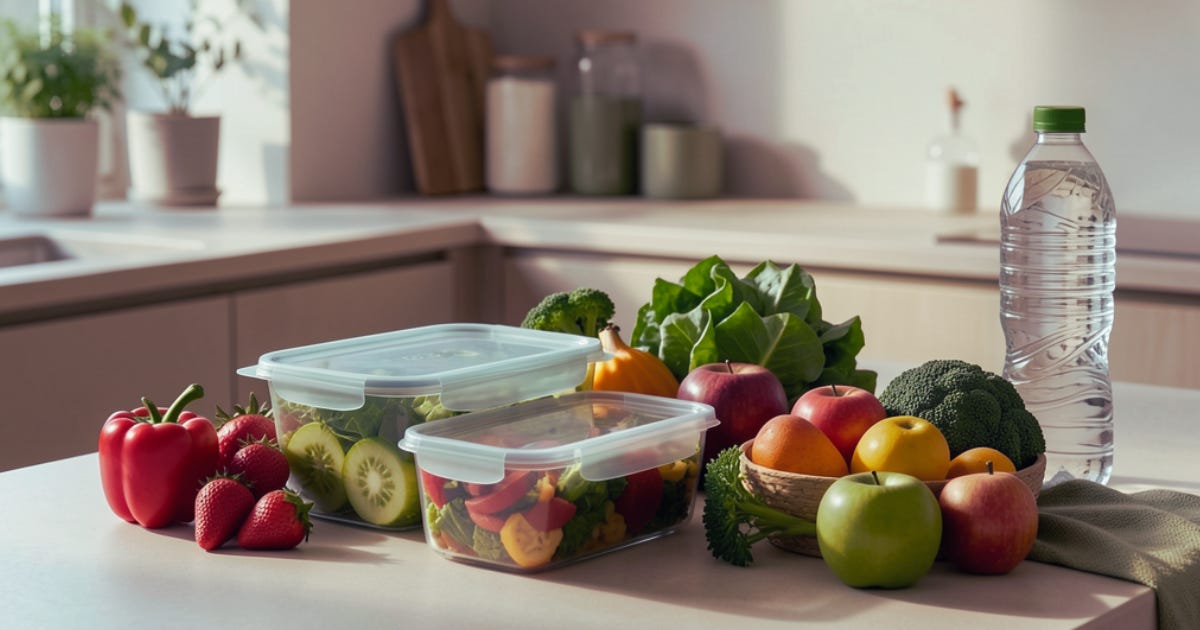
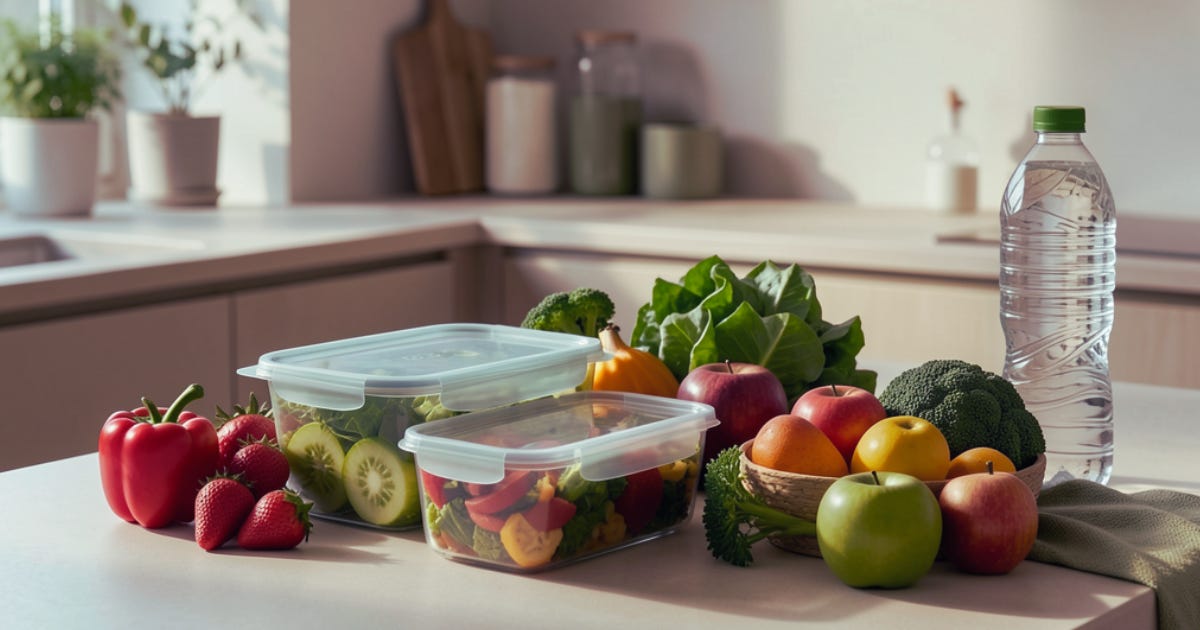
So I’ve landed on a middle ground that I can live with. I try not to heat food in plastic. We’ve gradually picked up some glass containers, and if I’m reheating something that’s what I reach for first. But we still have plastic ones too because they’re cheaper and lighter and we’re a normal family. I swapped out plastic utensils during my earlier kitchen cull, so it’s mostly wood and stainless steel now. We use a water filter, partly because our tap water is genuinely unpleasant. I open windows when it’s not freezing, vacuum when I remember, and we use stainless steel bottles – even if that means a lot of banging and the occasional sore foot when one gets dropped.
Plastic is everywhere. I can’t remove particles that may already be in food. I can’t buy everything unpackaged. Even tins often have plastic linings now. And I’m not going to throw out all my children’s toys and replace them with tasteful wooden alternatives if what they actually want is a glittery Elsa dress and a plastic tiara (which, incidentally, sometimes buys mummy five minutes of peace and quiet).
The more I’ve read about this topic, the more it seems to sit in a familiar category of health questions: there may well be a real signal here, but the scale of the risk is still uncertain, and our ability to control it individually is limited. That’s where the idea of a hierarchy becomes helpful. If we zoom out and look at the major drivers of disease across populations, things like smoking, diet quality, physical inactivity, alcohol, air pollution and socioeconomic conditions still dominate the picture.
Microplastics may eventually prove to be part of the story. The biological mechanisms are plausible and the early signals are worth paying attention to. But at the moment they sit somewhere in the category of possible environmental contributors, rather than a clearly established personal health lever we can easily pull.
So where I land, for now, is concern without panic. I’ll reduce exposure where it’s easy and sensible, but I won’t pretend I can eliminate it. I’ll keep an eye on the evidence as it develops, because this is clearly a field that’s moving. Above all, I’m trying not to let the stress of chasing perfect avoidance become another health risk in its own right.
Leave a Reply